


Louisa Carolina Colleton (Graves) (1763-1822) a reversal of fortune
- Don Schueler
- Dec 18, 2025
- 6 min read

Updated: Dec 29, 2025

Try out the podcast above for a great deep dive into Louisa's history.
The Colleton family, one of the prominent families in South Carolina's history, played a significant role in shaping the cultural and economic landscape of the Lowcountry. Arriving in the 17th century, they became influential planters and politicians, contributing to the development of the region's rice and indigo industries. Their legacy is marked by the establishment of grand plantations and the cultivation of a distinct Southern aristocratic culture. This includes the South Carolina Devils Elbow Barony (largely Bluffton, SC today) and the Fair Lawn Plantation in Moncks Corner, SC.
Through their political involvement and social influence, the Colletons helped to forge the identity of the Lowcountry, leaving an indelible mark on its history and South Carolina. Much of the Colleton holdings in the South Carolina low-country and the Caribbean island flowed to Louisa Carolina Colleton. This is her story.
Sir John Colleton - Carolina Lord Proprietor
Sir John Colleton (1608–1666), born in Exeter to a wealthy merchant family, sided with the Royalists during England’s Civil War. He donated heavily to King Charles I’s cause, lost property when the Royalists fell, and fled to Barbados in 1649. There, on a ridge overlooking the Caribbean, he built what became Colleton Great House and prospered as a sugar baron.

From Barbados, Colleton helped plan the settlement of the Carolinas. When King Charles II was restored to the throne, Sir John Colleton was rewarded with a baronetcy and named one of the eight Lords Proprietors of Carolina. His sons Peter and James both went on to govern the colony. Colleton Great House remained in the family until 1807.
Louisa Carolina Colleton Graves (1763-1822)
Louisa Carolina Colleton inherited significant land holdings from her father, Sir John Colleton (4th Bart). She led a notably eventful life, recording much of it in diaries that Kishanda Fulford, the wife of Francis Fulford, used in writing her book about Louisa titled ‘The Spite of Fortune.’ Louisa's mother was Ann Fulford.
Louisa Carolina Colleton inherited significant land holdings from her father, Sir John Colleton (4th Bart), a man of considerable influence and wealth in the 18th century. The lands she inherited were not merely vast tracts of property; they included fertile plantations that were crucial to the agricultural economy of the time, particularly in the production of cash crops such as rice and indigo. This inheritance positioned Louisa as a prominent figure within the social and economic landscape of her era, granting her both power and responsibility.
Throughout her life, Louisa experienced a series of notable events that shaped her character and her legacy. She navigated the complexities of colonial society, which was often marked by rigid social hierarchies and the challenges of maintaining one's status and wealth. Her diaries, which she meticulously kept over the years, provide an intimate glimpse into her thoughts, feelings, and daily life. They reflect not only her personal experiences but also the broader societal issues of her time, including the impact of colonial policies, the dynamics of family and marriage, and the struggles of managing large estates.
Kishanda Fulford is an accomplished author and historian, and the wife of Francis Fulford, the current heir and owner of the Great Fulford country estate. She drew heavily from these diaries, which she found in their library at Great Fulford, in her research and writing of the book titled ‘The Spite of Fortune.’ In this work, Fulford delves into Louisa's life, exploring the triumphs and tribulations she faced as a woman in a male-dominated society. The title itself suggests a narrative of resilience in the face of adversity, highlighting how Louisa's spirit and determination allowed her to carve out a unique identity amidst the challenges that surrounded her.
Fulford’s exploration of Louisa's life not only illuminates the personal struggles and victories of one woman but also serves as a lens through which to examine the broader historical context of the time. By analyzing Louisa's relationships, her management of her inherited estates, and her social interactions, Fulford provides readers with a rich tapestry of life in the colonial South, marked by both privilege and hardship. The diaries thus become more than mere records of daily events; they transform into vital historical documents that capture the essence of a woman who lived with both grace and fortitude in an era defined by its complexities.


Kishanda Fulford's book, The Spite of Fortune, gives an excellent detailed view of Louisa's life. Louisa's mother Ann was part of the Fulford family and was born and raised at Great Fulford estate.
A Unique Heritage
The Colleton family occupied a singular place in South Carolina’s history. Unlike other original Lords Proprietors, they were the only ones to establish a permanent family seat in the colony, building a massive brick mansion known as Colleton Castle at Fair Lawn Barony, now known as Fair Lawn Plantation, South Carolina, around 1730. It was here that Louisa Carolina Colleton was born.

Though her roots were in the Lowcountry, her childhood was split between the Cooper River and her mother’s ancestral home, Great Fulford in Devon, England. Her mother, Ann, eventually left the family to return to England permanently, leading to a bitter divorce in 1772. This fractured upbringing forced a young Louisa to cross the Atlantic multiple times—even surviving capture by pirates—displaying a courage that would define her later struggles to protect her inheritance.
War and the Ruin of Fair Lawn
In 1775, as the American War of Independence broke out, 13-year-old Louisa was sent to England for safety. Her father, Sir John Colleton, placed Fair Lawn and the "Devil’s Elbow" Barony (Today's Bluffton, SC) in trust for her, hoping to preserve her future.

However, Sir John’s attempt to remain neutral failed; he was viewed as a Tory by Patriots and his property was exploited by the British.



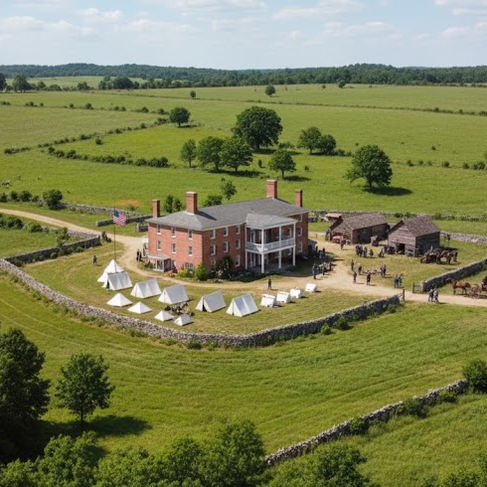
A watercolor and an AI rendering of Fair Lawn Plantation as it was during takeover by the British during the Revolutionary War, the Colleton plantation outside of Charleston. Fort Fair Lawn, a British redoubt/stronghold, was also built nearby. The fort remnants can still be seen today and can be visited.
By 1780, British forces had seized Fair Lawn, converting the mansion into a fortified supply depot and constructing Fort Fair Lawn nearby. The occupation was marked by tragedy:
Assault: Sir John’s second wife, Lady Jane, was assaulted and robbed by British troopers, forcing her to flee to nearby Mulberry Plantation.

Mulberry Plantation, built on land originally part of Fair Lawn. Lady Jane Colleton sought shelter here after being assaulted by Patriot troops at Fair Lawn. It still stands today. Death: Both Sir John and Lady Jane died at Fair Lawn during the war.
Destruction: In 1781, after American forces under Francis Marion captured the post’s hospital and supplies, the British abandoned the site. Upon leaving, they burned the mansion, the outbuildings, and an entire village on the Barony.
Louisa later estimated the loss at £30,000 (roughly £4.5 million today), noting the destruction of everything from granaries and mills to her personal jewels.
The image above is a great interactive view of Fair Lawn Plantation and Fort Fair Lawn and its role in the Revolutionary war done by https://thelibertytrailsc.stqry.app/ Click in the map above to take the tour.
A Disastrous Marriage
In 1787, the 24-year-old Louisa married Richard Graves, a 29-year-old naval captain.

While the match seemed promising—Graves eventually became a Rear-Admiral and inherited Hembury Fort in Devon—it proved financially ruinous.
The couple had ten children (notably, all eight daughters had names ending in 'a'). However, Richard was a spendthrift. Between his extravagance and the later mismanagement of their son, Samuel, Louisa’s vast inheritance was slowly bled dry. Her life became a series of dramatic shifts: one year attending social seasons in Bath with private carriages, the next living in a humble laborer’s cottage in Gittisham.

The End of an Era
In a final, desperate act to save her legacy, Louisa returned to South Carolina in 1821. She hoped to reclaim what remained of the Barony after Samuel had mortgaged the properties to cover his debts. Her efforts were in vain.
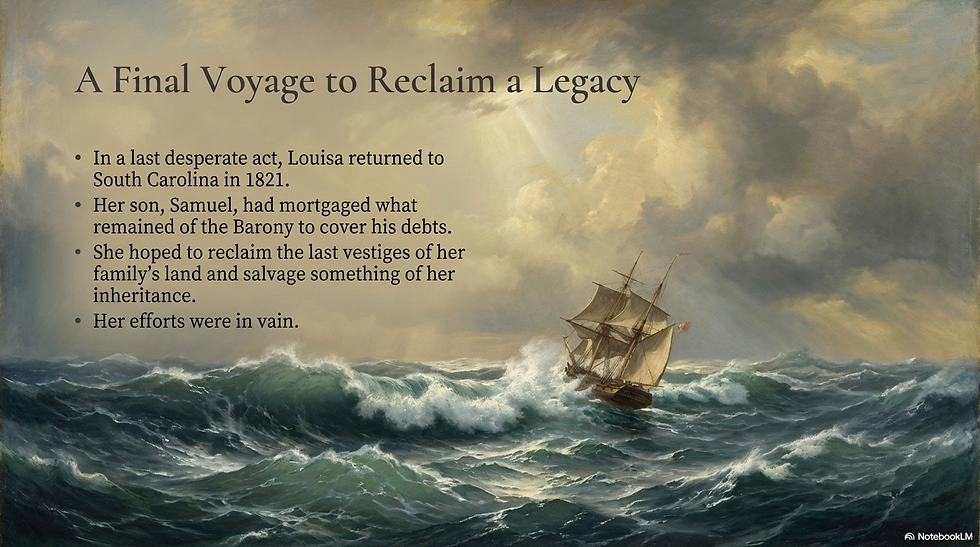
Louisa returned to England and died there impoverished in 1822 at the age of 59. Her husband, Richard, fled to Europe to escape his creditors shortly thereafter. By 1828, the final remnants of the Colleton estates—Fair Lawn and Devil’s Elbow (now encompassing Belfair and Rose Hill)—were sold and divided. The grand family seat that once defined the region was erased, leaving behind only the earthworks of the fort and the name of Colleton County as a reminder of their influence.
REFERENCES
Kishanda Fulford Interview about her book
Fair Lawn Barony - https://www.battlefields.org/learn/articles/colleton-castle-moncks-corner-south-carolina
Mulberry Plantation


Comments